
The Anatomy of Attrition:
Analyzing Instrumental Music Dropout Rates
Background
The desire to play an instrument is one of the few ambitions that transcends age. Whether it’s a seven-year-old picking up a violin for the first time or a forty-five-year-old finally sitting down on a keyboard, the dream is the same. Yet, the statistics tell a darker story. Across every demographic, the ‘Anatomy of Attrition’ is remarkably consistent: we start with a roar and end with a whimper. Why is the gap between starting and staying so wide, and is the cause the same for a child as it is for an adult?
Introduction
In this post, we look at the data for dropout rates in adults and children separately, as they are likely influenced by very different considerations.
Studies show that:
- 50% of all music students quit their instruments by age 17.
- The 3-Year Drop-off: After three years of lessons, only 1 in 5 students (20%) will continue their musical path.
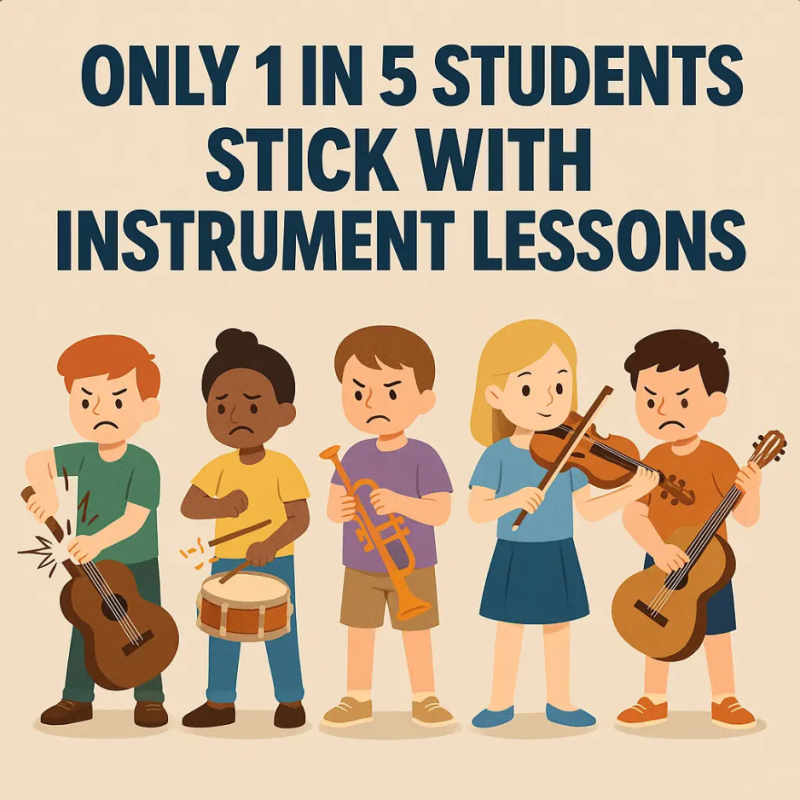
(Source: https://www.spinright.org/blog/dropout-rates-for-music-lessons/ )
The Adult Anatomy: Why Grown-Ups Walk Away
A deeper dive into adult dropout statistics
- The 90-Day Wall: While exact large-scale data for private adult learners is hard to track, private studio data often points to a “90-day window” where adults are most likely to drop out due to realistic progress frustration.
- Physical Friction: In surveys of adult learners, 60% cite hand coordination as a major struggle, and 70% find maintaining proper posture and technique “extremely challenging,” leading to early burnout.
Adult attrition is generally believed to be a “prefrontal cortex” problem. Adults bring a level of logic and expectation to the bench that can likely become their greatest hurdle.
Yet,
- The Aspiration Gap: A Gallup poll found that 85% of American adults who don’t play an instrument wish they had learned.
- The Participation Reality: Despite high interest, only 12% of adults are active in playing an instrument.
The “Taste-Skill” Gap (Cognitive Friction)
The most common cause of adult attrition is believed to be sophisticated musical tastes; they know what a professional violin or guitar sounds like. When an adult’s output (simple notes/ scales) doesn’t match their expected audio input (complex listening habits), a sense of “intellectual embarrassment” sets in. They quit not because they lack talent, but because they can’t stand the sound of being a beginner.
The “Time Poverty” Fallacy
Adults often approach music lessons with an “all or nothing” mentality. They believe that if they can’t dedicate 60 minutes of focused practice a day, the week is a “loss.” One busy work week leads to a missed lesson, which leads to guilt, which leads to “ghosting” their teacher. This is the Time Haemorrhage—the slow bleed of consistency.
The Paediatric Anatomy: The Great Middle School Migration
A Peek into Dropout statistics in Children
- The Age 11 Surge: Research identifies the first major “surge” of dropout at age 11 (the transition to middle school).
- The Final Adolescent Cliff: A second massive wave of attrition happens between ages 15 and 17 (the high school transition), where academic and social pressures peak.
In children, attrition isn’t a slow fade; it’s usually a sharp drop-off that coincides with developmental milestones. We can view this through few specific “anatomical” lenses.
The “Growth Plate” of Interest
There is a specific window—typically between ages 11 and 14—where a child’s identity begins to solidify. This is the “Great Competition.” Music begins to compete with high-stakes sports, digital social lives, and increased academic loads. If music is still viewed as a “parental requirement” rather than a “personal identity,” it is the first thing to be amputated from the schedule. The “Middle School Slump,” where we see the highest statistical dropout rates in the entire learning lifecycle.
Developmental Plateau (The Skill-to-Effort Ratio)
In the first six months, progress is rapid and exciting. You go from “nothing” to “songs” quickly. Eventually, every student hits the Intermediate Plateau. The effort required to get 10% better doubles, but the audible reward feels smaller. If a child hasn’t developed the “grit” or a growth mindset, they perceive this normal plateau as a “lack of talent” and give up.
Summary of Dropout
In summary:
- For the Child: The failure point is usually The Environment (No friends playing, too many other hobbies, parents stopped Nagging).
- For the Adult: The failure point is usually The Ego (Not sounding like a pro fast enough, feeling “too old” to learn, guilt over missed practice).
The Treatment Plan: Interventions for Every Age
To stop the “bleed” of attrition, we believe that change is needed in the environment for the child and the mindset for the adult.
For Paediatric Students (Children & Teens)
- The 70/30 Repertoire Rule: While 70% of the music could be “the vegetables” (notes, scales, method books), 30% could be “the dessert.” Let them choose a song from a video game, a movie, or YouTube. If they enjoy the sound they are making, they are less likely to walk away.
- The “Social Supplement”: If a child is in private lessons, they need a “social organ.” Enrol them in a summer rock camp, a weekend youth orchestra, or even a local “jam session.” Music must be a team sport to survive the middle school years.
- Removing the “Performance Anxiety” Block: Shifting the focus from one high-stakes annual recital to frequent, low-stakes “mini-concerts” for family or virtually with interested relatives or grandparents.
For Adults (Grown-Ups)
- Prescribing “Micro-Practicing”: Replace the 60-minute goal with the “15-Minute Minimum.” It is physiologically better for the brain to practice 15 minutes every day than 3 hours once a week. It lowers the barrier to entry and removes the “guilt” cycle.
- Managing the Ego (The Reality Check): Adults need to embrace being “bad” at something. Remind them that the goal isn’t Carnegie Hall—it’s cognitive health and stress relief.
- The Pivot, Not the Quit: If an adult is struggling with the complexity of the piano, they shouldn’t necessarily quit music. They might need to pivot to an instrument with a faster “initial win” curve, like the ukulele or a digital synthesizer.
The Universal Cure: The Growth Mindset
Regardless of age, the biggest predictor of retention is how a student views a “plateau.”
In this “Valley of Despair,” the student feels they aren’t getting better. The “treatment” is to show them historical progress—recordings from three months ago—to prove that the anatomy of their skill is, in fact, growing, even if it feels stagnant.
Conclusion
Attrition isn’t a failure of the student; it is often a failure of the system to adapt to the student’s changing anatomy. Whether you are a parent or an adult learner, remember that the goal of music education isn’t to create a flawless performer—it’s to keep the music alive for a lifetime. By recognizing the warning signs of the ’24-month cliff,’ we can intervene before the instrument starts to gather dust.
Next Steps
A follow-up part 2 on this topic will be published soon.
References & Citations
These references cover the core data points we’ve discussed and provide high-level academic backing for your blog.
- Müllensiefen, D., & Ruth, N. (2021). Survival of musical activities: When do young people stop making music? https://journals.plos.org/plosone/article?id=10.1371/journal.pone.0259105
- Chakravarthy, A. (2018, July 27). For three years, dropout rate 40 per cent at Ghantasala music college, and academic pressure blamed. The New Indian Express. https://www.newindianexpress.com/states/andhra-pradesh/2018/Jul/27/for-three-years-dropout-rate-40-per-cent-at-ghantasala-music-college-academic-pressure-blamed-1849155.html
- Gamin, R. M. (2005). Teacher perceptions regarding attrition in beginning instrumental music classes. https://www.researchgate.net/publication/258183509_Teachers’_perceptions_of_declining_participation_in_school_music
- Frontiers in Psychology (2024): Who stays? Who goes? Motivation and tendency to drop out in music schools
- SpinRight Academy (2025). Dropout rates for music lessons at an all time high. https://www.spinright.org/blog/dropout-rates-for-music-lessons/
- Hallam, S., & Himonides, E. (2022). The power of music: An exploration of the evidence of the impact of music on the intellectual, social and personal development of children and young people. Open Book Publishers. (Focus: Global perspective on music education benefits and retention). https://www.openbookpublishers.com/books/10.11647/obp.0292
- McPherson, G. E., & Davidson, J. W. (2002). Musical practice: Mother and child interactions. British Journal of Music Education, 19(2), 141-156. (Focus: The role of parental support in preventing paediatric attrition). https://www.researchgate.net/publication/248981408_Musical_Practice_Mother_and_child_interactions_during_the_first_year_of_learning_an_instrument
- Ng, W., & Hartwig, K. A. (2011). What determines a student’s choice of music in secondary school? Australian Journal of Music Education, 1, 60-72. (Focus: The “Middle School Slump” and competition with academic subjects). https://www.researchgate.net/publication/283784681_Australian_primary_students’_motivation_and_learning_intentions_for_extra-curricular_music_programmes
- Pitts, S., Davidson, J. W., & McPherson, G. E. (2000). Developing effective practice strategies: Case studies of three young instrumentalists. Music Education Research, 2(1), 45-56. (Focus: The “20-month mark” as a critical survival window). https://www.researchgate.net/publication/248981370_Developing_Effective_Practise_Strategies_Case_studies_of_three_young_instrumentalists

0 Comments